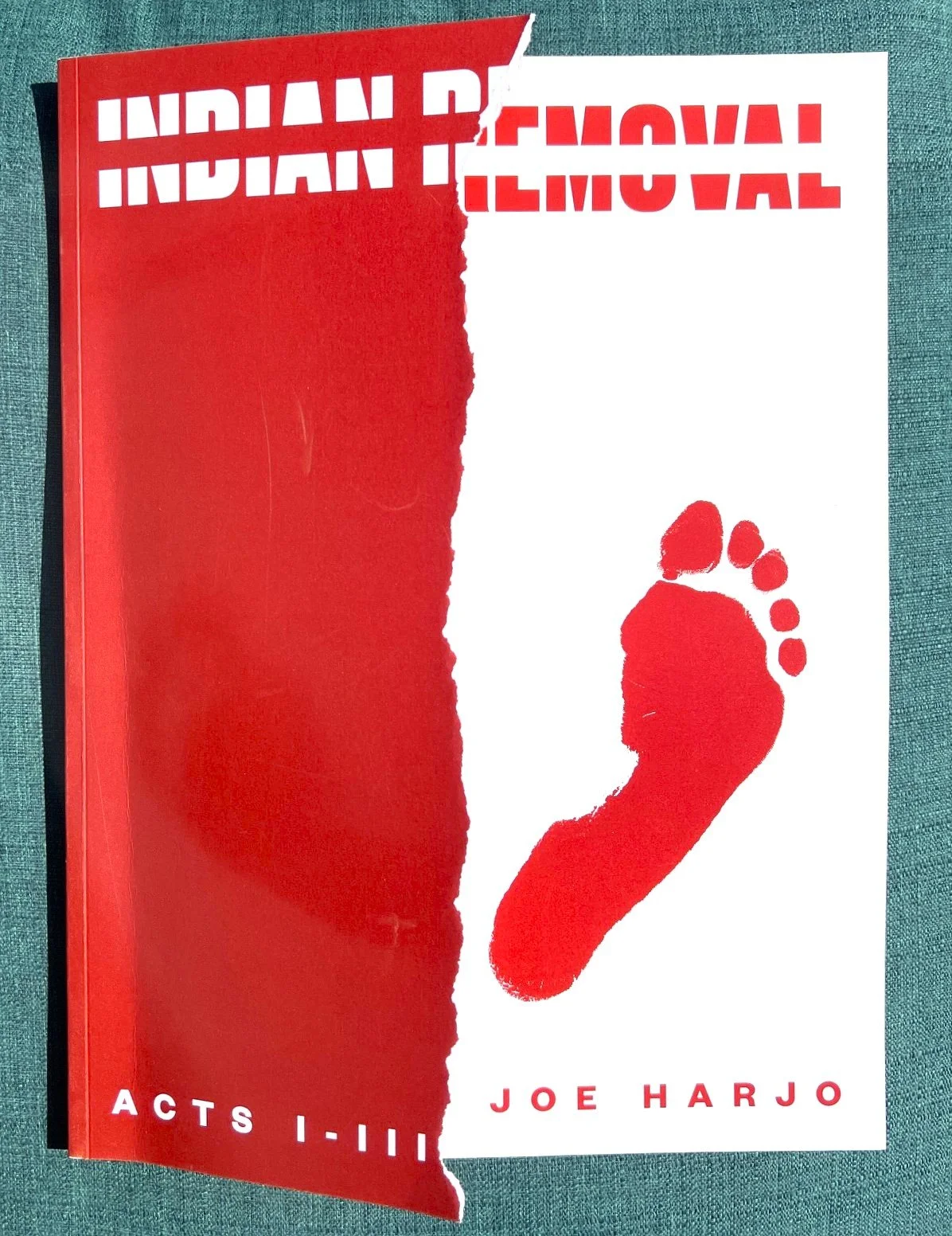
Indian Removal Acts I-III: Joe Harjo
Indian Removal Act I: AMERICAN PROGRESS,Galveston Arts Center, October 7, 2023 - January 7, 2024
Indian Removal Act II: And She Was, Contemporary at Blue Star, Feb 2–May 5, 2024
Indian Removal Act III: We are a Wounding, Fort Worth Contemporary Arts, August 30 – November 16, 2024
Click here to read publication.
Please contact me to receive a copy of this publication.
Indian Removal Acts I-III is a three-part exhibition series that explores the historical and contemporary issues that have affected Native American communities, their land and narratives. The title of Joe Harjo’s body of work derives from the Indian Removal Act of 1830, which forcibly relocated Native nations – including Harjo’s own, the Muscogee nation – to land not yet settled by colonists or within established state borders. Signed into law by President Andrew Jackson, the Act resulted in the breaking of historical treaties and the displacement of over 60,000 indigenous - - Cherokee, Chickasaw, Choctaw, Muscogee Creek and Seminole - - and enslaved peoples from the southeastern United States to unsettled locations west of the Mississippi River. Almost a quarter of these people died on the long walk west, and survivors faced hunger, disease and exhaustion.
Harjo has navigated this painful and bloody legacy on his own terms and Indian Removal Acts I-III is the culmination of his creative research over many years of reflection and making. The exhibition series is structured like a three-act play, recognized as a classic storytelling device that begins with an introduction, followed by conflict, and ending in resolution. However, Harjo’s presentation is not as neat and tidy as the strategy would suggest, but rather, his acts simultaneously scaffold and collapse upon each other. In Act I: AMERICAN PROGRESS Harjo activates the overarching narrative of forced removal by highlighting the influence of Christianity through early colonization and the later development of Manifest Destiny ideology as the nucleus of conflict. Harjo considers the ramifications of these actions leading to the exploitation and removal of Native communities and responds in Act II: And She Was, by focusing on Muscogee women, specifically the stories of Harjo’s family members. In doing this Harjo acknowledges the shift from matrilineal culture to patriarchy within the Muscogee nation as part of the wider removal story. While Acts I and II function as a conduit to look back and point to issues that impact the present, Act III: We are a Wounding prospects the futures of Native people as Harjo explores themes of harm, healing, resilience and care.
This publication brings all three acts together in one place and documents each exhibition presentation. It also features significant writing by Harjo and key contributors Colette Copeland, Jacqueline Saragoza McGilvray, Laura Phipps and Jodi Voice Yellowfish. Indian Removal Acts I-III is part exhibition guide, archive, memorial and a map for the future.
Funding for the publication Indian Removal Acts I-III is provided in part by the National Endowment for the Arts.
Joe Harjo is a multidisciplinary artist from the Muscogee (Creek) Nation of Oklahoma and currently teaches in San Antonio, TX. He holds a BFA in Visual Arts from the University of Central Oklahoma and an MFA from the University of Texas at San Antonio. Recent exhibitions include: Indian Removal Act II: And She Was, Contemporary at Blue Star, San Antonio, TX; Indian Removal Act I: American Progress, Galveston Arts Center, TX; High Visibility: On Location in Rural America and Indian Country, Plains Art Museum, Fargo, ND; Reimagining the Third Space, KCAI: Center for Contemporary Practice, Kansas City, Missouri; and, re/thinking photography: Conceptual Photography from Texas, FotoFest, Houston, TX. Harjo is a Skowhegan School of Painting and Sculpture Resident Alumni (2022), a Harpo Foundation Native American Residency Fellow (2020-21), recipient of the Blue Star Contemporary Berlin Residency hosted by Künstlerhaus Bethanien in Germany (2022-23), a Bemis Center for Contemporary Art Resident Alumni (2023), and a 2024 Joan Mitchell Fellow.
Publication design by Tony Carranza